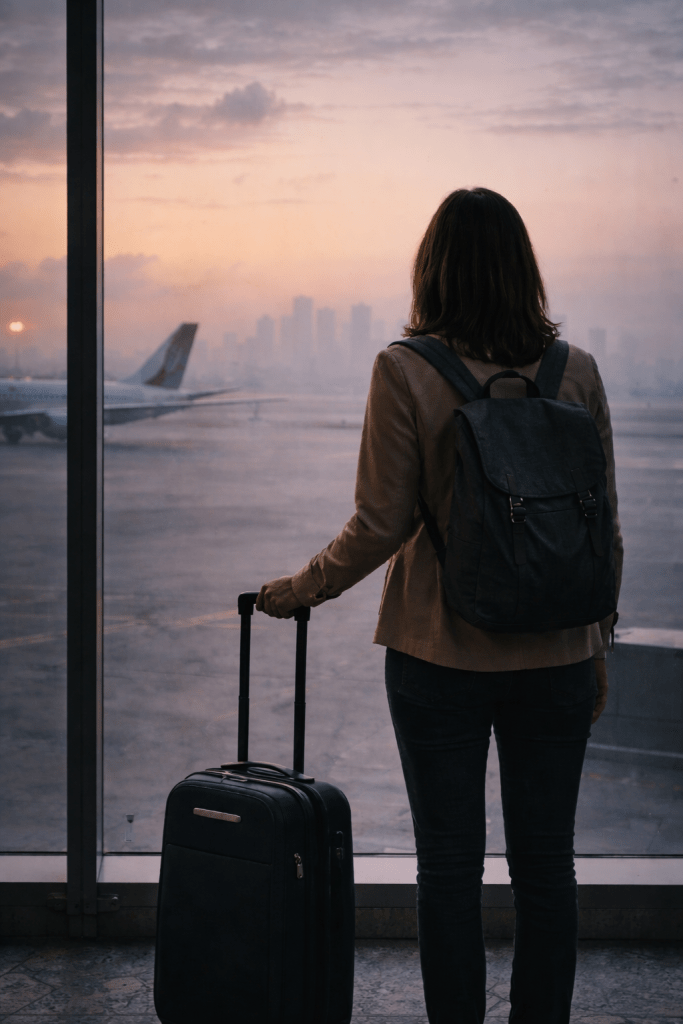
In the early hours of the 9th of March 2026, I left Doha, the place I called home for more than a decade, not knowing if I would ever return. My departure occurred under such unforeseen and unexpected circumstances that I feel I was forcibly displaced.
But, before I delve deeper into my story, I want to state that I am not comparing myself to hundreds and thousands of Internally Displaced Persons (IDPs) and refugees who flee their homes due to conflict, violence, and persecution with minimal resources and pathways for safety in countries such as Sudan, Palestine, Afghanistan and Syria. I understand that I come from a position of privilege in terms of finances, education, and networks of friends and relatives who would be willing to provide a roof over my head at any time.
The night before leaving
A few hours before the decision to depart was made, I was sharing food and playing board games with my friends—something we had started doing daily as a coping mechanism since the outbreak of the war on the 28th of February. The missile and drone interceptions did not sound too frightening when you were surrounded by close friends and good food, and the ability to talk about our shared fears and frustrations was much needed to relieve stress at the end of the day. When I left my friend’s place on the 8th night, I never imagined it might be for the last time.
In the early hours of the 9th, my husband found seats on a flight to Perth, Australia, and unilaterally decided that we would fly there and decide the rest afterwards. While I felt safe inside my apartment despite the ongoing missile attacks and loud interceptions, the situation was taking a toll on the mental health of my family, both in Doha and Sri Lanka. At that point, it was no longer within my control whether I remained in Doha or not.
Since Qatari airspace had been closed for commercial flights from the 28th of February, we had discussed crossing into Saudi Arabia through the Salwa land border and staying in Riyadh temporarily, while monitoring the situation before deciding on our next steps, including a possible return to Sri Lanka. But this was always framed as a contingency plan—one I deliberately avoided thinking about, because I did not want to leave. When limited flights resumed on the 8th of March, Colombo was not among the destinations in the first couple of days, which is how Perth became our only option at the time.
While I am an Australian PR holder, moving to Australia had always existed in my mind as a distant backup plan, obtained in the aftermath of Sri Lanka’s economic crisis in 2022. I had dreaded the thought of eventually having to move there, leaving behind the life I had built in Doha. Perth, in particular, was not even remotely on my mind. I hardly knew anyone there.
Leaving without closure
I packed my belongings in a haze, unable to decide what mattered enough to take and what could be left behind. While I knew that Doha was not a permanent home, it was a long-time home, and leaving required a sense of clarity about what came next.
Over the decade I lived in Doha, I saw many people leave. While departure was often part of household economic strategies, and sometimes due to layoffs, most people had at least a month or two to prepare. This sudden, midnight decision meant that I had no time to prepare emotionally or say goodbye to my friends, or to the home I had lovingly nurtured over the years.
The 10-minute drive to Hamad International Airport felt surreal. I had taken that route many times before—when going on vacation, or picking up and dropping off friends. It was always associated with anticipation and the certainty of return. This time, I did not know if I would return at all.
The airport itself felt strangely normal. Passengers—many of them transit travellers stranded due to airspace closures—sat calmly, sipping coffee and working on their laptops. The take-off took longer than usual, and I found myself hoping, quietly, that the flight would be grounded. It was only after crossing Qatari airspace that things became real. I had left Doha. Possibly forever.
Transit and return ‘home’?
We left without knowing where we would stay in Perth. Midway through the approximately 14-hour flight, I messaged a cousin I had not spoken to in years, asking if we could stay for a night until we found a hotel. I remain deeply grateful to him and his wife, not only for picking us up but for hosting us for several days, cooking Sri Lankan food, and caring for us during a difficult time.
We eventually booked tickets to Sri Lanka for the 13th. After another 24 hours of travel via Hong Kong, we arrived in Kandy, at my in-laws’ house, a place I had previously associated only with short visits during vacations, never “home” in any lasting sense.
Home beyond logic: transnational belonging
I was based in Doha because my husband worked there, while my own work with international partners was conducted remotely. Logically, I had no reason to remain in Doha. And yet, emotionally, it was my home—the place I looked forward to returning to after every trip.
While I lived in Doha on a resident permit renewed annually, over time it became home—the only home I had after marriage. We had a rented apartment that I had put great effort into nurturing. I had a group of friends from different nationalities whom I considered family. I had a collection of plants that I cared for daily. It was my home, the place where I felt most settled.
My experience reflects what migration scholars describe as everyday transnationalism, where belonging is stretched across borders rather than anchored in a single nation-state.
Rethinking displacement through lived experience
I have been working with displaced populations for more than half a decade, engaging with academic scholarship on identity, home, and belonging. But I had never fully understood the extent of its implications.
While working with IDPs in Jaffna, Sri Lanka, I often wondered why some refused alternative land plots offered by the government and insisted on returning to their places of origin, even when those lands were located in areas designated as high-security zones during Sri Lanka’s civil war and remained out of bounds for civilians to date. Now I understand that the sense of home and belonging is deeply personal, and not easily substituted.
My experience also taught me that even within the same family, the degree of displacement, sense of belonging, and identity can vary greatly. It also pushed me to reflect more critically on the gendered dimensions of displacement. Home, material belongings, and attachment to place may be more pronounced for women, yet they are often less involved in decision-making processes.
This resonates with scholarship that conceptualises home not as a fixed geographic space, but as an affective and relational construct shaped by memory, attachment, and everyday practice.
Being ‘home’, yet displaced
While I was able to work in Doha despite the intermittent missile and drone interceptions, since my sudden departure, it has been exceptionally difficult to concentrate. I find myself constantly checking the Al Jazeera live blog every few minutes, hoping for news that signals an end to the war—so that I might return home. Each new update about attacks or alerts sends me searching through WhatsApp messages to confirm that my friends are safe.
One of the hardest aspects of returning is that friends and family in Sri Lanka do not understand the sense of displacement I feel. Many assume I must be relieved to be safe from missiles; some have even joked about it. I often begin to explain, and then stop midway, unsure how to translate what this loss feels like.
While my immigration status in Qatar was temporary, it was my home. And despite returning to my country of origin, I feel disoriented and displaced. Repeatedly explaining that this was not my choice and that I felt safe there has become exhausting.
It is also difficult to explain to those outside the GCC how safe one can feel in Qatar, especially as a woman. There is little fear of being robbed or sexually harassed. Once you become accustomed to that level of everyday safety, it is difficult to leave it behind.
I tried to write this piece several times, but felt overwhelmed each time. I hope that writing this proves somewhat cathartic and brings me enough clarity to recommence work.
Falling outside categories
From an academic perspective, I find myself in an in-between space. There are no existing frameworks that fully explain my situation. I feel I was forcibly displaced from the place I call home due to conflict, but I am neither an internally displaced person, nor a refugee, nor an asylum seeker.
This raises important questions about the limits of existing displacement categories, which remain tied to legal definitions rather than lived experiences of rupture, loss, and coercion.
Perhaps displacement is not only about crossing borders under duress, but about being severed—suddenly and without closure—from a place that has come to hold one’s sense of self.
If you would like to connect or collaborate, please feel free to reach out. I will respond as my mental health permits, as I recover from this experience.
Date: 20 March 2026
About the author
Dr Anoji Ekanayake is a researcher based in Qatar and Sri Lanka with experience in migration and displacement research. She earned her PhD from the University of Colombo, Sri Lanka, where her research focused on the return, reintegration and remigration of Sri Lankan migrant workers from the Gulf region. Her scholarly contributions have been published in leading migration-related journals, such as Comparative Migration Studies, International Migration, Journal on Migration and Human Security, Migration Studies and Refugee Survey Quarterly.
Anoji is a Senior Researcher at the Centre for Migration Research and Development (CMRD) in Sri Lanka, currently working on an implementation research project addressing the psychosocial well-being of displacement-affected communities in Northern Sri Lanka. She also serves as a Visiting Fellow at the Toronto Metropolitan University, Canada, examining multinational migration from the Gulf region to Australia and New Zealand. She also serves as a contract-based Postdoctoral Research Assistant at the Australian National University, where she collaborates with Dr Matt Withers on a project investigating the migration of nurses from Sri Lanka. Previously, she was affiliated with the Gender, Justice and Security Hub at the London School of Economics and Political Science in the UK, working on projects related to migration and displacement.
 The Migrant