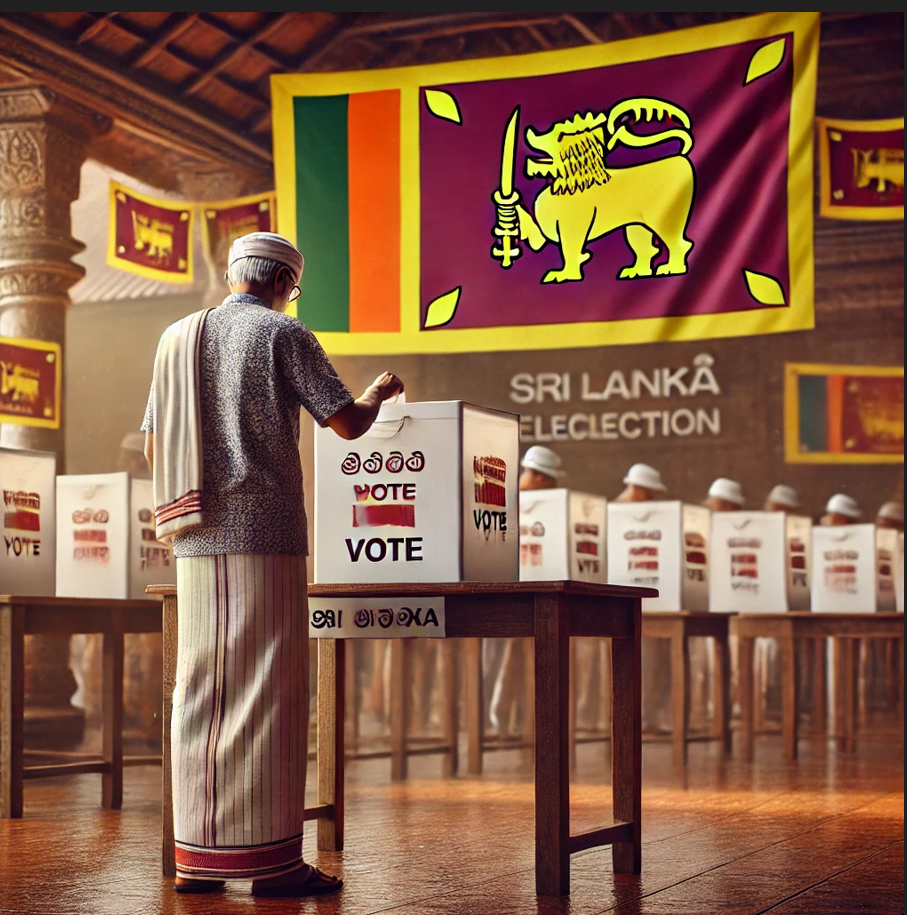
As the Sri Lankan presidential election on September 21, 2024, draws near, the nation is abuzz with anticipation over who will guide the country through the lingering aftermath of the 2022 economic crisis. Soon, nearly 17 million registered voters will receive the voting cards needed to cast their ballots and choose the next leader. Yet, amid this democratic process, a significant group—between 1.5 and 2 million Sri Lankan overseas residents—will find themselves excluded, unable to participate in shaping the future of their homeland.
These overseas Sri Lankans play a crucial role in sustaining the Sri Lankan economy. Accounting for approximately 25% of the labour force, they alleviate pressure on the local job market and help stave off high unemployment rates. For a country burdened with foreign debt, remittances from overseas residents, which exceed earnings from traditional sectors like apparel, tourism, and tea, serve as a lifeline. These remittances provide essential consumption and capital injections into the national economy, easing the country’s foreign exchange needs. In 2019, for example, remittances from overseas Sri Lankans amounted to USD 6.7 billion, making up 56% of the nation’s overall foreign exchange earnings and contributing 7.8% to the GDP.1 Yet, despite their crucial economic role, these citizens are relegated to the sidelines during every election, left to watch from afar with a sense of frustration and helplessness.
A significant portion of these nearly two million overseas Sri Lankans are migrant workers on employment visas, primarily in the Middle East. Unlike their counterparts in Western countries such as Australia, Canada, New Zealand, and the United Kingdom, these workers do not have the option of permanent settlement, regardless of how many years they spend abroad. Their migration journey is irrevocably tied to their eventual return to Sri Lanka, making their economic contributions through remittances even more vital. In 2019, Middle East-based contract migrant workers alone were responsible for 51.5% of total remittances, underscoring the importance of including them in the electoral process.
Although migrant workers returning to Sri Lanka specifically to exercise their right to vote became a hot topic during the presidential election of 2019, the reality is that the vast majority of overseas Sri Lankans cannot afford the cost of airfare just to cast a ballot. Many also reserve their precious annual leave to visit Sri Lanka during festive seasons like Sinhala and Tamil New Year, Christmas, and Eid. Despite being rightful citizens whose earnings are indispensable to the economy, these overseas residents remain ‘forgotten voters’—their voices unheard, their votes uncast.
Ignoring the voices of these 1.5 to 2 million citizens—who make up a significant 9% to 12% of registered voters—could sway the outcome of any election in Sri Lanka. Worse still, there have been instances where the families of migrant workers have been coerced into surrendering their voting cards to political goons, who then misuse these votes for their own ends. In such cases, not only are these citizens denied their right to vote, but their votes are also exploited for political gain.
Despite discussions on granting extraterritorial voting rights to overseas Sri Lankans spanning more than two decades, progress has been scant. The Universal Declaration of Human Rights (UDHR), the International Covenant on Civil and Political Rights (CCPR), and the International Covenant on the Protection of Migrant Workers and their Families (ICMW), all ratified by Sri Lanka, guarantee the voting rights of overseas residents of Sri Lanka. The Sri Lankan National Migration Policy of 2008 and the Human Rights Action Plan 2011-2016 also recognised the importance of enfranchising overseas citizens. Civil society organisations and migrant rights groups, such as Rata Giya Aththo, Community Development Services (CDS), Action Network for Migrant Workers (ACTFORM), and People’s Action for Free and Fair Elections (PAFFREL), have tirelessly lobbied policymakers for years for a system that includes these citizens. Yet, ironically, while many presidential candidates in both present and past elections have campaigned in foreign countries, no provisions have been made to allow overseas Sri Lankans to vote. Despite the formation of parliamentary committees from time to time, such as those in April 2016 and May 2021, no significant steps have been taken to amend the Parliamentary Elections Act or to make overseas voting a logistical reality.
Globally, Sri Lanka is one of the few countries that is yet to make legal provisions allowing non-resident citizens to vote in elections from abroad. As of 2020, 141 countries have implemented legal frameworks that enable non-resident citizens to participate in their home country’s elections.
While allowing overseas Sri Lankans to vote might be seen as an expensive endeavour, many lower-middle-income countries like Sri Lanka have successfully implemented such systems. The Philippines, for example, a country with a large migrant population like Sri Lanka’s, legalised overseas voting in 2003 and allowed its citizens abroad to participate in elections from 2004 onwards. On the other hand, while South Asian countries such as Bangladesh, Pakistan, India and Nepal are yet to organise voting from abroad, they have adopted extraterritorial voting laws in 2009, 2013, 2015, and 2018, respectively—steps in the right direction.
Eleven countries—spread across Europe (Croatia, France, Italy and Portugal), Africa (Algeria, Angola, Cape Verde and Mozambique), and the Americas (Colombia, Ecuador and Panama)—have gone a step further by not only allowing their citizens abroad to vote but also enabling them to elect their own representatives to the national legislature, which gives them the opportunity to have representatives in the parliament who can address their unique needs.
Countries that permit overseas residents to vote employ various methods, including:
- Personal voting: Voting in person at diplomatic missions or specially designated polling places abroad. This is the most common method of voting from abroad.
- Postal voting: Casting a ballot from a chosen location and sending it via regular mail to the home country, sometimes requiring witnesses to confirm the voter’s identity and free will.
- Proxy voting: Allowing a designated proxy to cast the vote on the voter’s behalf, either in the home country or abroad.
- Electronic voting: Utilizing the Internet, mobile phones, or other electronic means to cast a vote.
Some countries allow a combination of these methods, while others rely on a single approach.
Sri Lanka does not need to adopt all these methods simultaneously, nor must it implement overseas voting across all countries at once. A gradual, phased introduction could allow the system to evolve, addressing challenges as they arise and ensuring the process is secure and transparent. The first phase could focus on introducing overseas voting for migrants in the Middle East, who account for the majority of Sri Lankans intending to return home. Subsequently, the system could be extended to destinations with significant numbers of Sri Lankan student migrants.
Conclusion
Sri Lanka’s failure to include overseas residents in the electoral process not only undermines the democratic principle of universal suffrage but also neglects a crucial segment of its citizenry whose contributions are vital to the nation’s economy. As the country approaches another pivotal election, it is essential for policymakers to address this glaring oversight and ensure that all Sri Lankans, regardless of where they reside, have a voice in their homeland’s future.
By implementing a fair and accessible system for overseas voting, Sri Lanka would not only honour the democratic rights of its citizens but also strengthen its connection with a vital economic partner—its diaspora. The experiences of other countries that have successfully integrated overseas voting systems provide a valuable roadmap for Sri Lanka. Embracing these practices, even through a phased approach, can help bridge the gap between the diaspora and their home country, ensuring that every Sri Lankan has a stake in the democratic process.
End Notes
- Data from 2019 is included as there are fluctuations in the data for the 2020-2022 period due to the COVID-19 pandemic and the economic crisis in Sri Lanka, which affected the general remittance patterns of Sri Lankans.
References
ACE Electoral Knowledge Network. (n.d.). Out of Country Voting. The Ace Project: The Electoral Knowledge Network. Retrieved August 27, 2024, from https://aceproject.org/ace-en/topics/va/annex/country-case-studies/the-philippines-the-first-experience-of-external
Colombage, Q. (2017, June 30). Voting rights of Sri Lankan migrant workers “not a priority” [News]. Union of Catholic Asian News. https://www.ucanews.com/amp/voting-rights-of-sri-lankan-migrant-workers-not-a-priority/79629
Election Commission. (2023). Comparative note on the number of registered voters registered according to the electoral district 2014-2023. Election Commission. https://elections.gov.lk/en/voters/voters_statistics_E.html
Fierro, C. N., Morales, I., & Gratschew, M. (2007). External voting: A comparative overview. In Voting from Abroad: The International IDEA Handbook. Institute for Democracy and Electoral Assistance and The Federal Electoral Institute of Mexico.
International Organisation for Migration. (2022). Migration Governance Indicators – Sri Lanka Second Profile 2021.
Kirinde, C., & Nasry, L. (2001, December 2). Barred from the ballot. The Sunday Times. https://www.sundaytimes.lk/011202/plusm.html
Mahanamahewa, P. (2015, January 6). Migrant workers’ voting rights. Daily Mirror. https://www.dailymirror.lk/opinion/migrant-workers-voting-rights/172-60467
Nadja Braun, & Gratschew, M. (2007). Introduction. In Voting from Abroad: The International IDEA Handbook. Institute for Democracy and Electoral Assistance and The Federal Electoral Institute of Mexico.
Sarah Hannan. (2020, February 2). Call for voting rights [News]. The Morning. https://themorning.lk//articles/69433
SLBFE. (2023). Annual Statistical Report of Foreign Employment—2022 (Annual Statistical Report 27). Sri Lanka Bureau of Foreign Employment.
Wellman, E. I., Allen, N. W., & Nyblade, B. (2022). The Extraterritorial Voting Rights and Restrictions Dataset (1950–2020). Comparative Political Studies. https://doi.org/10.1177/00104140221115169
About the author
Anoji Ekanayake is a researcher based in Sri Lanka and Qatar with extensive experience in migration and displacement research. She earned her PhD from the University of Colombo, where her research focused on the return, reintegration, and remigration of Sri Lankan migrant workers from the Gulf region. Her scholarly contributions have been published in international journals, including Comparative Migration Studies (Springer), Refugee Survey Quarterly (Oxford Academic), and Migration and Development (Routledge). Currently, she serves as a Senior Researcher at the Centre for Migration Research and Development (CMRD). Before joining CMRD, Anoji was affiliated with the Gender, Justice and Security Hub at the London School of Economics and Political Science (LSE).
Date: 29 August 2024
 The Migrant